
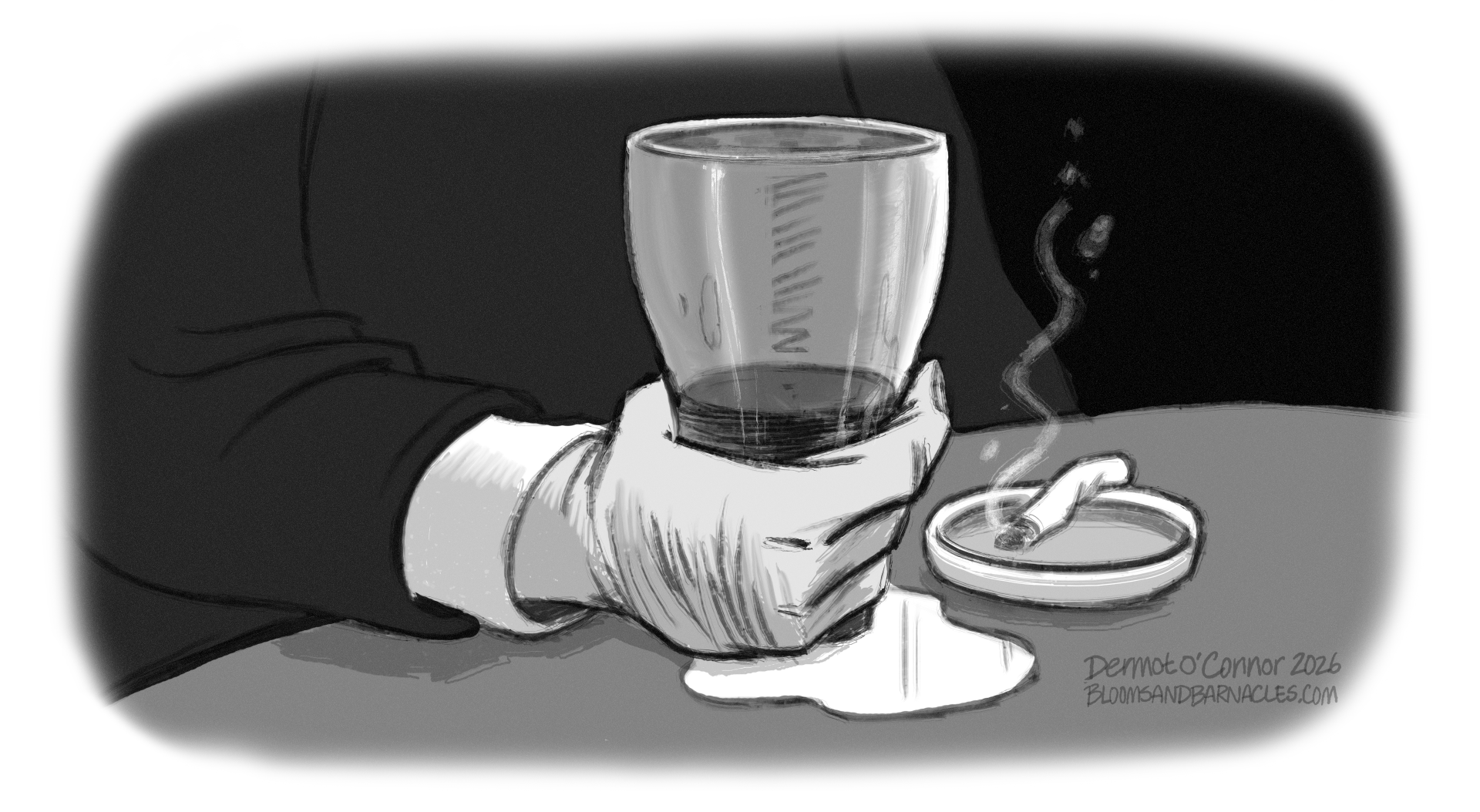
“Cyclops,” Ulysses’ twelfth episode, is delivered through the colorful narration of an anonymous patron of Barney Kiernan’s pub, occasionally interrupted by elaborate comedic interpolations. Our main POV characters are either totally absent (in Stephen Dedalus’ case) or totally subsumed by the Narrator’s running commentary on the events unfolding in the pub in the early evening of June sixteenth. James Joyce considered including Stephen among the barflies in the pub in early drafts of “Cyclops,” though he ultimately decided to leave Stephen out altogether. This isn’t the first time Bloom has been viewed unfavorably through the eyes of other Dubliners, but The Cyclops Narrator may be his biggest hater.
Professionally, the Cyclops Narrator is a “collector of bad and doubtful debts” and informally a purveyor of hot gossip. He knows everybody else’s business and wields his allegations like a knife. And while he has nothing good to say about anybody, he is, in truth, a wordsmith in his own right, working in shit-talk the way other artists might work in marble or oils. If you met him, you wouldn’t want to get too close, but you might want to get just close enough to hear his stories. Scholar David Hayman wrote, “in another epoch [the Cyclops Narrator] would have been a professional storyteller and satirist, a man represented and feared by Irish kings.” Truly the bard of the lower middle class, the seanchaí of the streets.
The Cyclops Narrator’s manner of delivery confers him a kind of dirtbag authority. He undercuts Bloom’s intellectualizing with an appeal to the common touch and a rejection of Bloom’s jargon-filled explanations. The Cyclops Narrator can instantly discredit and disparage him because he can frame Bloom as a know-it-all putting on airs, no matter whether Blooms is actually right or wrong. Bloom begins the episode as the target of cynicism and is easily twisted into a monster by the end of the episode. We as readers become complicit in the Cyclops Narrator’s bigotry and ill-treatment of Bloom to some extent as we are drawn into his version of events. Even if we know he’s an unreliable narrator, he’s right enough of the time to not dismiss him entirely. In the end, we recoil as his irreverence turns to rank antisemitism, but we also laughed along at some point. The Cyclops Narrator ’s authority derives from the fact that he’s entertaining. In the back-and-forth of pub banter, the worst thing you can be is boring, and the Cyclops Narrator is never boring.

We don’t know much more about the Cyclops Narrator outside his general line of work and his presence in the pub. We don’t know his name or his personal history. He appears later in “Circe” as The Nameless One, but he is never called or remembered by name by any of the other men he shares a pint with in Barney Kiernan’s. Hayman suspects this “bitter gnome” is merely tolerated out of fear. After all, the Cyclops Narrator knows their dirty laundry, so they do not want to provoke him. Hayman, a fearless scholar, further disparages him as a “drifter” and opines that he may have “turned his hand to many jobs and failed at all of them.” Despite his notoriety in the pub, the Cyclops Narrator is fairly obsequious to institutional power and prefers to lash out at people he perceives as weak. Within the first few words of “Cyclops” he is seen palling around with “old Troy of the D. M. P.,” or Dublin Metropolitan Police, but then spends the rest of the episode railing against the many crimes of Leopold Bloom, a man who holds neither economic nor political power in the hierarchy of Dublin society. At the conclusion of the episode, the Cyclops Narrator’s greatest concern at the Citizen’s attempt to hate-crime Bloom is what kind of punishment the Citizen and Joe Hynes might face at the hands of the State had the Citizen been successful:
“Gob, if he got that lottery ticket on the side of his poll he’d remember the gold cup, he would so, but begob the citizen would have been lagged for assault and battery and Joe for aiding and abetting.”
Scholar Richard Ellmann wrote that the Cyclops Narrator “pretends to be an outlaw, but no one minds more sheepishly than he the tables of the law.” Of course, the Cyclops Narrator’s ties to police power also mark him as a possible police informant. This could mean that running afoul of the Cyclops Narrator would result in more than reputational damage; old Troy of the D.M.P. might come knocking at your door one night if you weren’t careful.

Such a memorable figure must surely have some real-life counterpart, as so many Ulysses characters do. However, there isn’t a single agreed-upon model for the Cyclops Narrator. Scholar Eishiro Ito goes so far as to compare the persistence of this mystery to the true identity of the shadowy man in the mackintosh. Personally, I think that the Cyclops Narrator is a composite character of men Joyce might have encountered in pubs around Dublin. Naturally, scholars have theories about his identity. Ellmann points to a brother of the Joyces’ neighbor Ned Thornton as the “principal model” of the Cyclops Narrator, citing him also as a model for such disparate Joycean Expanded Universe characters as Tom Kernan and Eveline’s father from Dubliners. Ellmann further cites Joyce’s father John Stanislaus Joyce as the model for the Cyclops Narrator’s “eloquence,” particularly the “eloquent abuse” he reserved for his in-laws (who become the Gouldings in Ulysses). Ellmann also saw a classical inspiration in the character of the Cyclops Narrator, describing him as Thersites in his discussions of the “Cyclops” episode in the book Ulysses on the Liffey. Thersites appears only briefly in The Iliad, and not at all in The Odyssey. He is a physically disabled soldier who is vocally critical of Agamemnon until Odysseus tells him to sit down and shut up. Ellmann wrote that Joyce privately identified the Cyclops Narrator as Thersites, “the meanest-spirited man in the Greek host at Troy.” Joyce’s friend Frank Budgen also affirms the Thersites parallel in his book James Joyce and the Making of Ulysses, writing that the Cyclops Narrator, “himself a snarling Thersites, he liberates the Thersites in us.”
And what of John S. Joyce’s eloquent abuse? The Cyclops Narrator certainly possesses an abusive eloquence, rivaling that of Simon Dedalus, John S. Joyce’s literary counterpart. Simon, like the Cyclops Narrator, possesses the bitterness of Thersites, and certainly is willing to unleash his wrath on those he perceives as weaker than himself. We see this most vividly in the scene in “Wandering Rocks” where Simon berates Dilly in front of the auction house. On the other hand, it’s hard to imagine the Cyclops Narrator bursting into a gorgeous rendition of a famous aria. Despite his failures as a father and provider, Simon is popular in his social circle, while the Cyclops Narrator creeps at the margins.
Scholar E.I. Schoenberg takes this idea one step further and postulates that the Cyclops Narrator is Simon Dedalus. In part, Schoenberg sees a strong parallel in how Simon snaps at the lacquey outside Dillon’s auctionrooms (“Curse your bloody blatant soul”) and how the Cyclops Narrator lets the chimney sweep “have the weight of [his] tongue” in the opening lines of “Cyclops.” Never trust a man who mistreats service workers. The core of Schoenberg’s theory centers on the overlap of the Cyclops Narrator and John Joyce’s professions. The Cyclops Narrator is a debt collector, while John Joyce worked for the Office of the Dublin Collector-General of Rates from 1882 to1893. John Joyce was ousted from his position when he got into trouble “borrowing” rate money and using it for personal purposes. The Cyclops Narrator has at least in the past worked as a rate collector, someone who goes door to door collecting taxes. He even had a sarcastic nickname for Blazes Boylan’s father from his rate collector days:
“Old Whatwhat. I called about the poor and water rate, Mr Boylan. You what? The water rate, Mr Boylan. You whatwhat?”
We can also infer that the Cyclops Narrator is in a new line of work collecting debts based on this exchange with Joe Hynes early in “Cyclops”:
“—That the lay you’re on now? says Joe.
—Ay, says I. How are the mighty fallen! Collector of bad and doubtful debts.”
Joe’s question and the response of “How are the mighty fallen” would seem to imply he had once held a more prestigious position and has been demoted more recently. This could map onto John Joyce’s fall from grace or could affirm Hayman’s assertion that the Cyclops Narrator is a shiftless job-hopper who doesn’t keep any position all too long, depending on how you read it.
Schoenberg pulls in additional evidence from Simon’s appearances in “Wandering Rocks” and “Sirens.” In “Wandering Rocks,” we see a quick vignette of Simon with his friends Ben Dollard and Fr. Bob Cowley discussing Cowley’s dire situation with his landlord. Their scene ends with the three of them together. However, Simon arrives at the Ormond Hotel in “Sirens” well in advance of Dollard and Cowley, who arrive together. What happened in between? Dollard suggests that they consult sub-sheriff Long John Fanning and head towards his office. Schoenberg argues that Simon made some excuse and peeled off before they reached Fanning’s office. This is reinforced as we see Simon alone as the Viceregal Cavalcade passes, while we don’t see Dollard and Cowley again until “Sirens” (possibly because they are in a meeting with Fanning and don’t witness the passing procession). Schoenberg’s contention is that this is because Simon is a debt collector on the down-low, working for Fanning, and is, in fact, one of Cowley’s creditors. As such, he didn’t want to show his face in Fanning’s office. Schoenberg points out that the text of “Sirens” references Judas Iscariot just as Simon enters the room to greet Dollard and Cowley.
While I definitely find Schoenberg’s theory interesting, I don’t really think the Cyclops Narrator is Simon. He is too starkly different in character from the Simon who breaks down in tears in “Hades” or the Simon who sings so soulfully in “Sirens.” He is most similar to the Simon who verbally abuses Dilly in “Wandering Rocks,” but Simon doesn’t seem to carry that hatefulness into his social life. I don’t know why Simon wouldn’t be acknowledged by his friends in Barney Kiernan’s like he is elsewhere, though maybe he’s not including that in the retelling (we’ll return to that thought momentarily). I also don’t know what the narratives or themes of this episode gain by concealing that it’s actually Simon telling the story. I suppose Joyce liked his mysteries and puzzles, but this one seems like a dead end to me.
Let’s explore one final theory of the identity of the Cyclops Narrator. Joyce scholar Naoki Yanase, the Japanese translator of Finnegans Wake, theorized that the Cyclops Narrator was, in fact, a dog. According to Ito, this theory was hard to sell to Western Joyceans, but Japanese scholars were “impressed” with Yanase’s hypothesis. Yanase’s argument centers around the notion that “Dog” is an inversion of “God,” and that the Cyclops Narrator is treated by the other patrons as more of a “creature” than a man. Yanase paid particular attention to the use of the phrase “let him have the weight of my tongue” from the opening lines of the episode, as this is reminiscent of the phrase “to give tongue,” meaning the baying of hunting dogs when they’ve caught a scent. So, is the Cyclops Narrator really a dog? Ito wrote that for this to be true, you’d have to convincingly be able to replace any portion of his speech with the phrase “bow wow,” and at least for Ito, this is far too subjective a measure. Yanase also viewed the Cyclops Narrator’s fear of Garryowen as proof that he is a rival dog, but it is hard to square this with the Cyclops Narrator’s concern that Garryowen might pee on his leg, a rather non-canine concern. Yanase countered that if these logistical concerns have you doubting his theory, you may be thinking too “realistically” about the matter. Ulysses is fiction, and in fiction you can bend the rules of reality freely to fit your artistic aims. Ito pointed out that the greatest weakness of Yanase’s theory is that he doesn’t take Joyce’s manuscripts into account. Yes, the Cyclops Narrator is nameless, so perhaps he’s some stray cur that wandered in off the street to narrate this tale? The Citizen is also nameless, but he was named Michael Cusack in early drafts while the Narrator has always been nameless. On the other hand, Joyce also failed to mention or consider the fact that the Narrator might be a dog in his own manuscripts.
Whether canine or human, there is also the question of how many Narrators “Cyclops” has. We’ve mainly focused on the Narrator sometimes called the I Narrator or the Nameless One, as he is styled in “Circe.” But what about the many satirical intrusions that also characterize the episode? Who is speaking those? This has been a real quandary in the scholarship over the years. The idea that there are dual dueling narrators in “Cyclops” lends itself to the episode’s technic of gigantism. Both convey a sense of grandiosity to their narration. Ellmann argues that the I Narrator denigrates and deflates gigantically while the Intrusion Narrator inflates grandiosely and gigantically, so much so that a flying biscuit tin can set off a major seismic event that destroys the entire neighborhood. Neither is accurate, but rather Cyclopean or one-eyed in their approach. In Ellmann’s words:
“Thersites can take fairly innocent acts and make them out to be vile, his counterpart takes vile acts and makes them part of a frothy blancmange.”
Ellmann further notes that the Linati schema for “Cyclops” lists Galatea among the classical figures represented. In myth, Galatea was a nymph who catches the eye of the Cyclops Polyphemus, but she does not return his affection. The Intrusion Narrator’s view of the world as grandiosely beautiful demonstrates Galatea’s point of view “unyielding” in the face of Polyphemus’ violence and Thersites’ cynicism. I think there are some limits to this idea as there is parody and cynicism to the Intrusions as well, as demonstrated in the execution scene. Schoenberg has an explanation, as he interprets the Intrusions as springing from the mind of Simon Dedalus as well, representing a second, more literary aspect of Simon’s skill as a “natural-born raconteur.” Schoenberg further imagines that the intrusions are meant to be spoken, and that they could represent Simon recounting the story of the Citizen and Bloom’s altercation to Stephen on the 17th of June.
Scholar Hugh Kenner likens the Intrusions to the headlines of “Aeolus” or even the heresiarch intrusion in “Telemachus,” introducing fantastical or overblown descriptions alongside more mundane narration to highlight the themes of past glory days pined for in the present. Scholar Daniel Schwarz argues that both narrators introduce a degree of “male aggressiveness” in line with the Cyclopean personality, with both claiming to speak for Ireland while exposing “the pretence and insincerity of the other.” Schwarz goes so far as to say that the I Narrator abuses the spoken word while the Intrusions abuse the written word in the attempt. Interestingly, Joyce wrote out the Intrusions before the main body of the episode, so if anything they are the true Narrator Prime (Scholar Michael Groden described them as the “germ” of the episode rather than the I Narrator’s commentary).
The dueling narrator theory has its critics, however. Scholar Karen Lawrence counters that, when it comes to the Intrusion Narrator, it is “too difficult to read as the product of a second narrative voice in the text.” There’s no real reason to stretch interpretations this far when it suffices that the Intrusion Narrator is just the third-person omniscient voice that appears elsewhere in Ulysses (and in literature more broadly) without question or hand-wringing as to its identity. The intrusions speak as a collective voice representing the nation of Ireland, but because they are stripped down and repackaged as epic, romantic narration, they become fantastical and unreliable, or, in Lawrence’s words, an Irish epic transformed into ad copy for tourists. Their breathless oversimplification, in Lawrence’s view, could make the Cyclops Intrusions the stories to accompany those Aeolus Headlines.
A final (cordially) raging debate among Joyce scholars is when exactly the telling of the story of the face-off between Bloom and the Citizen takes place. We know that the events take place around 5 pm, but there is disagreement as to whether the Cyclops Narrator is giving a play-by-play to us readers as shit goes down or if we are actually listening to a retelling much later in the evening recounting the events of “Cyclops.” The main proponent for the idea that Cyclops Narrator is recounting the story at some later time is scholar David Hayman. His theory hinges around what he terms the “famous gonorrheal micturition”:
“Goodbye Ireland I’m going to Gort. So I just went round the back of the yard to pumpship and begob (hundred shillings to five) while I was letting off my (Throwaway twenty to) letting off my load gob says I to myself I knew he was uneasy in his (two pints off of Joe and one in Slattery’s off) in his mind to get off the mark to (hundred shillings is five quid) and when they were in the (dark horse) pisser Burke was telling me card party and letting on the child was sick (gob, must have done about a gallon) flabbyarse of a wife speaking down the tube she’s better or she’s (ow!) all a plan so he could vamoose with the pool if he won or (Jesus, full up I was) trading without a licence (ow!) Ireland my nation says he (hoik! phthook!) never be up to those bloody (there’s the last of it) Jerusalem (ah!) cuckoos.”

The Cyclops Narrator steps out of the pub at a certain point to have a piss. He first narrates his exit and then complains about Bloom’s alleged secret winnings from the Ascot Gold Cup. Hayman interprets the piss as “gonorrheal” because the Narrator says “ow!” a couple times near the culmination. Hayman views the setting of this passage as proof that the narration is taking place at least a few hours after the fact. Hayman speculates that after witnessing the fracas in Barney Kiernan’s, the Cyclops Narrator has been bumming drinks in exchange for recapping the Bloom v. Citizen showdown. We do see some boozy accounting in this paragraph (“two pints off of Joe and one in Slattery’s off”). Hayman calculates, based on the volume of the Cyclops Narrator’s stream (“gob, must have done about a gallon”) that he has consumed around 8 pints and that this is actually the narration of a much later urination at some other pub that is interrupting a retelling of the story rather than the initial events. Hayman argues that the later narration also accounts for the massive overreaction to Bloom’s refusal to treat. While Bloom is certainly committing a party foul in Barney Kiernan’s, it is transformed into a major transgression by the gigantism of the episode. Gigantism transforms a minor (and boring) error of manners into a gossipy epic about how the sinister Jew is defrauding the good men of Ireland.
That last point is what elevates the debate of when the narration occurs from an Easter egg hunt for subtle clues to a more meaningful dissection of this passage. Scholar Margo Norris wrote that this debate ultimately matters to the “mechanics of anti-semitism.” No matter when the story is being told, the results are dangerous and “catastrophic” for Bloom as the Cyclops Narrator’s allegation of Bloom’s secret winnings is totally false but strongly reinforces anti-semitic stereotypes. However, if we’re hearing a running commentary as events unfold, it can be interpreted as a story colored by the Cyclops Narrator’s personal animus against Bloom. It’s obvious that he doesn’t have all the information, he’s at least three pints deep, and he was already biased against Bloom before the Gold Cup ever entered the conversation. On the other hand, if the Cyclops Narrator is telling the story after the fact and rumors have already begun to fly, his narration becomes witness testimony. Any negative opinion he holds of Bloom is justified by Bloom’s alleged bad behavior and reinforces the notion that Bloom is a greedy Jew rather than a victim of circumstance and of bigotry. As readers, we are the only spectators that have full knowledge of this situation. Bloom, alone, will have to face the reputational damage inflicted on him on June seventeenth and after.
Further Reading:
- Budgen, F. (1972). James Joyce and the making of Ulysses, and other writings. London: Oxford University Press. Retrieved from https://search.library.wisc.edu/digital/AMF2PZFZHI2WND8U
- Ellmann, R. (1972). Ulysses on the Liffey. Oxford University Press. Retrieved from https://archive.org/stream/in.ernet.dli.2015.65767/2015.65767.Ulysses-On-The-Liffey_djvu.txt
- Gifford, D., & Seidman, R. J. (1988). Ulysses annotated: Notes for James Joyce’s Ulysses. Berkeley: University of California Press. Retrieved from https://tinyurl.com/vy6j4tk
- Hayman, D. (1974). Cyclops. In C. Hart & D. Hayman (eds.), James Joyce’s Ulysses: Critical essays (91-114). Berkeley: University of California Press. Retrieved from https://tinyurl.com/wu2y7mg
- Ito, E. (1997). The Nameless Narrator and Nationalism: A Study of the “Cyclops” Episode of Ulysses. The Harp, 12, 103–112. http://www.jstor.org/stable/20533369
- Kenner, H. (1987). Ulysses. Baltimore: The Johns Hopkins University Press.
- Lawrence, K. (1981). The odyssey of style in Ulysses. Princeton, N.J. : Princeton University Press. Retrieved from https://tinyurl.com/yer4ddfa
- Norris, M. (2006). Fact, Fiction, and Anti-Semitism in the “Cyclops” Episode of Joyce’s “Ulysses.” Journal of Narrative Theory, 36(2), 163–189. http://www.jstor.org/stable/30224645
- Osteen, M. (1995). The economy of Ulysses: making both ends meet. New York: Syracuse University Press. Retrieved from https://tinyurl.com/yycf2ar5
- Schneidau, H. (1978). One Eye and Two Levels: On Joyce’s “Cyclops.” James Joyce Quarterly, 16(1/2), 95–103. http://www.jstor.org/stable/25476172
- Schoenberg, E. I. (1976). The Identity of the “Cyclops” Narrator in James Joyce’s “Ulysses.” Journal of Modern Literature, 5(3), 534–539. http://www.jstor.org/stable/3831085
- Schwarz, D. (2004). Reading Joyce’s Ulysses. Palgrave Macmillan.
- Simpson, J. Collecting the rates. James Joyce Online Notes. Retrieved from: https://www.jjon.org/jioyce-s-people/rates-1
Leave a Reply