
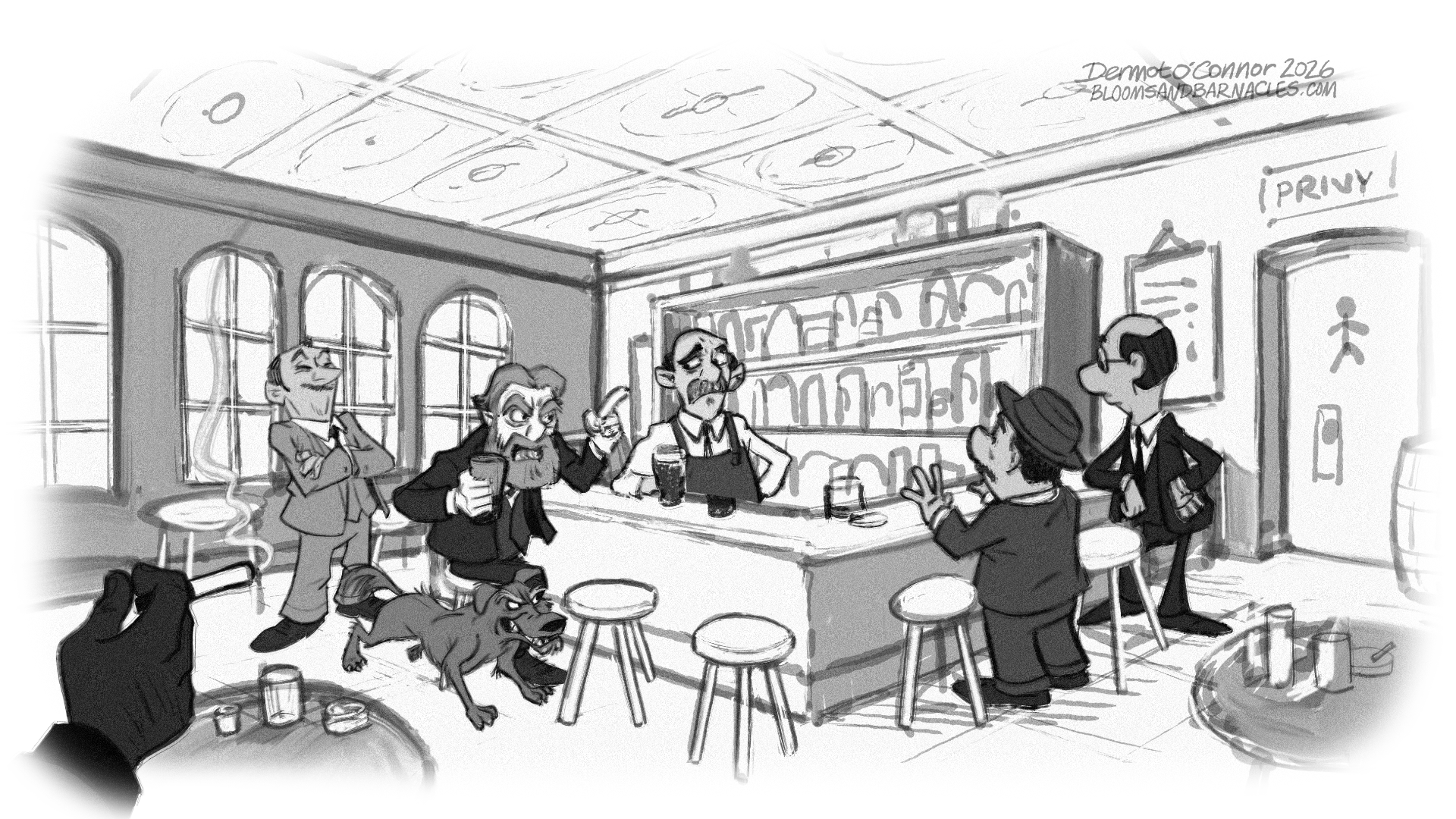
This post is a part of an occasional series on the real people behind the characters in Ulysses.
Sometimes you want to go where everybody knows your name, and unfortunately for Mr. Bloom, everyone seems to know all his business in Barney Kiernan’s pub.

In “Cyclops”, the twelfth episode of Ulysses, Leopold Bloom shows up to Barney Kiernan’s pub to meet with Martin Cunningham to help untangle Paddy Dignam’s life insurance. Martin is running late, so Bloom is subjected to the whims and abuse of the cast of colorful characters that populate 1904 Dublin’s answer to Cheers. The atmosphere at Barney Kiernan’s pub is described by scholar Daniel Schwarz as “asexual male camaraderie,” though I think it would be more accurately described as a fantastic example of toxic masculinity: a bunch of grown men acting like schoolboys, gossiping, bullying, and jockeying for position in the social hierarchy. The two most prominent members of the clique, the Narrator and the Citizen, will be covered in their own separate posts. For now, let’s take a look at the real men who inspired the denizens of Barney Kiernan’s pub.
Barney Kiernan’s

Barney Kiernan’s was a real pub located on the north side of the Liffey, just around the corner from the Green Street Courthouse. It’s no longer open as I write this in 2026, but the building is for sale (though you will need to apply for planning permission). Daft doesn’t currently list a price, but it was valued at €700,000 back in 2020, so if you have about a million euro (figuring in repairs and rising property prices) and a heart of gold, you could make a bunch of literary nerds really happy.
Given the pub’s proximity to the courthouse, it was a popular watering hole for the legal profession, nicknamed the “Court of Appeals” by the regulars. Reportedly, both Daniel O’Connell and the Earl of Dudley had once been patrons. Barney Kiernan was a collector of crime memorabilia, including hangman’s glasses, alleged murder weapons, and counterfeit coins, the latter of which were nailed to the bar. The pub began to decline in the 1920’s when the majority of Dublin legal business moved to the Four Courts. Both Stuart Gilbert and Frank Budgen visited Barney Kiernan’s during its declining years. Gilbert described it as “deep into decline” by 1939. Budgen described the pub as “still going strong” when he visited but acknowledged that its heyday was fifty to one hundred years in the past. Budgen recalls chatting with the proprietor who had a different diagnosis of his pub’s decline, complaining that “the art of and the taste of conversation” has been ruined by cinema, football, and “puritan licensing laws.”
Alf Bergan

Alf Bergan’s name is first evoked by Bloom in “Lestrygonians” as a likely culprit for the sender of the infamous U.P:up postcard:
“U. p: up. I’ll take my oath that’s Alf Bergan or Richie Goulding.”
Nuncle Richie doesn’t have much to say about Denis Breen in “Sirens”, but when we meet Alf in “Cyclops”, he appears as an impish prankster preoccupied with Denis Breen’s erratic reaction to receiving the postcard. He never openly admits to the prank, but I suppose a criminal always returns to the scene of a crime. Scholar David Hayman describes Alf as the “embodiment of Irish laughter and mockery,” viewing him as a largely benign if somewhat puckish presence in Barney Kiernan’s.
The real Alfred Bergen (it’s unclear to me why Joyce changed the spelling of his surname) was longtime friend to James Joyce and his father John S. Joyce. Much like his literary counterpart, the real Bergen was a short king (hence “Little Alf Bergan”) with a big sense of humor. Joyce biographer Richard Ellmann writes of Bergen as a frequent houseguest in the Joyce home and a teller of many “scatological stories.” Bergen eventually acted as the executor of John Joyce’s will and helped James organize his father’s gravestone in Glasnevin Cemetery.
Bergen worked as the assistant to John Clancy, aka Long John Clancy, the sub-sheriff of Dublin, portrayed in both Ulysses and Dubliners as Long John Fanning. The fictional Alf Bergan works in a similar capacity and is reasonably well connected. For example, in “Wandering Rocks”, we observe Ben Dollard consoling Bob Cowley about his landlord trouble by assuring him that “Alf Bergan will speak to the long fellow.” The one thing that Clancy couldn’t stand was hangings, which were rare enough in Dublin in that era. All the same, on the occasion where a hangman was needed, Clancy delegated the hiring to Bergen, who was equally reluctant. Thus, we see Alf reading out a letter of application from a too-eager barber/hangman in the early pages of “Cyclops.”
Joyce family lore has it that the real Alf Bergen received just such a letter from a barber/hangman named Billington who was a little too zealous for such grisly work. Billington wrote that he would be in Ireland on his holidays during the period of the upcoming hanging and would be happy to stop by on his way back home to do the deed. Billington also bragged in the letter about his skills “fastening and pulling nooses.” Do what you love and you’ll never work a day in your life.
This tale is reimagined in Ulysses, as fictional Alf Bergan shows off the lurid cover letter of H. Rumbold the Master Barber to the boys in the pub, which also asserts, “i have a special nack of putting the noose once in he can’t get out….” I’m on the fence about whether the Billington story is a tall tale or not. The Weekly Freeman published a story in January 1899 about a too-eager hangman named Billington who had come to Ireland from England and hanged three men within a week. Rumbold the Barber cites Billington in his letter of application, possibly as a reference or inspiration: “… Billington executed the awful murderer Toad Smith….” The real life Billington was a landlord on top of being a barber and hangman, making him all the most loathsome kind of multihyphenate. Billington died ironically of pneumonia that developed from a cold he caught while on the scaffold in 1901. It’s easy to see how real hangman’s letters, already a gruesome curiosity, could get mixed with the story of an infamous real hangman to take on the status of family legend.
John Wyse Nolan
John Wyse Nolan enters Barney Kiernan’s accompanied by Lenehan, though these two are not necessarily compatriots. Lenehan is simply clinging to him like a remora for the moment. John Wyse brings news to the Citizen of a recent meeting about the revival of the Irish language. John Wyse is cordial and not as volcanic in temperament as the Citizen. He also doesn’t share the Citizen’s immense hatred of Bloom. He recognizes Bloom’s empathy and kindness in “Wandering Rocks”, though he praises Bloom backhandedly with a quote from The Merchant of Venice:
“—I’ll say there is much kindness in the jew, he quoted, elegantly.”
In Barney Kiernan’s, John Wyse is not totally won over by Bloom’s weak debate performance, but he concedes, “Isn’t that what we’re told. Love your neighbour” as Bloom limply stakes his defense of pacifism. John Wyse sides with Bloom as the argument escalates, though we miss the details as the Narrator opts to use that moment in the debate to go have a piss, eliding over the finer details. One detail we do learn is that John Wyse claims that Bloom gave Arthur Griffith the idea for Sinn Fein, a comment that has perplexed Joyce critics for decades. John Wyse may be subtly hinting that Bloom is on the right track politically. This adds to my personal theory that Bloom was more politically radical at some point in the not too distant past. John Wyse defends Bloom again, this time without any allusions to Shylock:
“—And after all, says John Wyse, why can’t a jew love his country like the next fellow?”
The real John Wyse Nolan was a man named John Wyse Power, no relation to Mr. Jack Power, another character in Ulysses based on a separate Joyce family friend. John Wyse Power began his career as a civil servant, but in the words of Vivien Igoe, “felt obliged to leave on account of his political sympathies.” Wyse Power was a dedicated Irish nationalist and lent his efforts to a constellation of nationalist political causes. He was a fluent Irish speaker, a member of the Society for the Protection of the Irish language, and an editor of the Gaelic Journal, hence in Ulysses he has come from the caucus on the Irish language in order to “bring once more into honour among mortal men the winged speech of the seadivided Gael.” Wyse Power was also a founding member of the Gaelic Athletic Association, along with Michael Cusack, the real life model for the Citizen. Wyse Power acted as secretary of the GAA from 1884 to 1887, and Igoe explains that “athletics were among his main interests in life.” On top of all of this, Wyse Power was a dedicated conservationist, thus his interest in the trees of Ireland in “Cyclops.” The fictionalized John Wyse Nolan transcends the status of a mere tree hugger as he literally marries a tree in the guise of Jean Wyse de Neaulan in one of the episodes many interstitials.
Just like his fictional version, Wyse Power was no pacifist. He spent time in prison for his activities with the Land League, and was reputed to have been involved with the Irish Republican Brotherhood, or IRB. Also known as the Fenians, the IRB was a secret organization dedicated to Irish Independence. The IRB sometimes used violence to achieve their goals. We’ve discussed them in relation to the Clerkenwell bombing here. The Invincibles, who carried out the Phoenix Park Murders, were a splinter group of the IRB. While Wyse Power didn’t directly take part in the Easter Rising, he was supportive of the Rising. It follows, then, that as Bloom simply argues against racial injustice that Wyse Power goads him to “Stand up to it then with force like men.” The fictional John Wyse Nolan’s political views are subtly telegraphed throughout his brief appearances in the novel. In addition to his advocacy for force while debating Bloom, in “Circe” he declares Bloom “the man that got away James Stephens.” This was a common expression in the early 20th century in Ireland, but given that James Stephens was the president of the IRB, it carries a deeper implication in this context. The Fenian is the symbol of “Cyclops,” and John Wyse Nolan acts as a foil to the Citizen’s bombast. This is underscored by John Wyse’s reaction to the passing viceregal cavalcade:
“…John Wyse Nolan smiled with unseen coldness towards the lord lieutenantgeneral and general governor of Ireland.”
Fenians take many forms. By knowing John Wyse Power’s biography, we can understand that John Wyse Nolan stands as a counterpoint to the Citizen’s chauvinism. John Wyse Nolan does everything the Citizen claims to do, but better, highlighting the Citizen inactiveness on these issues. He actually speaks Irish and puts in time at the meetings to affect its revival, he’s actively involved in the GAA, he takes active measures to protect the natural environment, and he is willing to put his physical safety and freedom on the line to enact political change. The Citizen claims to have met the Fenian Kevin Egan in Paris once. Egan and John Wyse Nolan may have been comrades in arms in the IRB prior to Egan’s wild goose flight to the continent. The Citizen just bullies people in a seedy bar, all smoke, no fire.
There is one final reference to John Wyse Nolan in Ulysses. In “Lestrygonians,” Nosey Flynn lets the other men in Davy Byrne’s know he had seen Bloom “…coming out of that Irish farm dairy John Wyse Nolan’s wife has in Henry street….” The real Jennie Wyse Power ran a restaurant and shop in Henry St. called the Irish Farm Produce Company. The restaurant was popular with members and sympathizers of the Gaelic League and the IRB, including Arthur Griffith, John MacBride, and Seán T. O’Kelly. During the Easter Rising, Jennie Wyse Power supplied food from her restaurant to the men fighting in the GPO. She would later serve as a senator from 1934 to 1936.
Pisser Burke
Pisser Burke never appears on the page, but we still catch a whiff of him here and there. He was named “Stink Burke” in an early draft of the episode. We learn in “Ithaca” that his first name is “Andrew” and that he appears disconcertingly on the list of Molly’s suspected suitors. Pisser Burke’s main contribution is acting as an informant to the “Cyclops” Narrator, spying on regular citizens and disseminating the embarrassing details of their intimate lives to the Narrator, who can then pass it on in Barney Kiernan’s for some petty social capital.
In Stanislaus Joyce’s biography of his brother James, My Brother’s Keeper, he recounts a story of getting into a fight with a childhood bully nicknamed “Pisser Duffy.” Stanislaus mentions that the character James Duffy is based on him, with Pisser Duffy as an ironic namesake. Joyce biographer Ellmann wrote that Burke was based on a real man known as Pisser Duff. He made money brushing down horses while their owners drank in pubs. Ellmann describes Pisser Duff as looking innocent on the surface while having a violent streak. He was beaten to death by police in 1892, though Ellmann doesn’t elaborate. It’s also not clear to me if Pisser Duffy matured into Pisser Duff or if there were two people with a similar nickname.
Rumbold, Bennett & Carr
The last category of minor characters are grouped as receivers of what scholar Mark Osteen likens to Odysseus’ gift to Polyphemus or even the Trojan Horse itself: being included in Ulysses as retribution for slights great and small against James Joyce.
While living in Zurich in the late 1910’s, Joyce worked as the business manager for a theatre company called the English Players. They mostly produced Irish plays and were supported by the British government. The company staged a production of The Importance of Being Earnest, in which a British consulate employee named Henry Carr was cast in the leading role of Algernon Moncrieff. After the play closed, Carr and Joyce got into a dispute over pay. Carr felt he was underpaid, while Joyce countered that Carr had libeled him in the dispute over Carr’s pay. Their argument escalated into a protracted lawsuit, with Carr suing the English Players for money owed and Joyce countersuing Carr for libel. Joyce reached out to the British consul-general of Zurich, Percy Bennett, for support, but the consul was completely unsympathetic to Joyce’s complaint of libel. Joyce also appealed to the British minister of Switzerland, Sir Horace Rumbold, but his complaints once again fell on deaf ears. At trial, Carr lost his suit for money owed, while Joyce was unable to produce evidence of libel in court and lost his libel case. The English Players folded in 1920, but Joyce’s feud with Carr was immortalized on the stage in Tom Stoppard’s play Travesties.
Joyce did his own immortalizing as well. In Ulysses, Carr becomes an English soldier who knocks Stephen down in Nighttown. Bennett becomes an English boxer who gets pummeled by Dublin’s pet lamb, Myler Keogh. And H. Rumbold becomes a bloodthirsty English master barber and hangman.
Further Reading:
- Adams, R. M. (1962). Surface and symbol: The consistency of James Joyce’s Ulysses. New York: Oxford University Press.
- Budgen, F. (1972). James Joyce and the making of Ulysses, and other writings. London: Oxford University Press. Retrieved from https://search.library.wisc.edu/digital/AMF2PZFZHI2WND8U
- Ellmann, R. (1959). James Joyce. Oxford University Press.
- Gilbert, S. (1930). James Joyce’s Ulysses: a study. New York: Vintage Books. Retrieved from https://archive.org/details/in.ernet.dli.2015.124373/page/n3/mode/2up
- Hayman, D. (1974). Cyclops. In C. Hart & D. Hayman (eds.), James Joyce’s Ulysses: Critical essays (91-114). Berkeley: University of California Press. Retrieved from https://tinyurl.com/wu2y7mg
- Igoe, V. (2016). The real people of Joyce’s Ulysses: A biographical guide. University College Dublin Press.
- Joyce, S. (1958). My brother’s keeper: James Joyce’s early years. New York: The Viking Press. Retrieved from https://tinyurl.com/yra2d3xd
- McGee, O. (2009). Power, John Wyse. In Dictionary of Irish Biography. https://www.dib.ie/biography/power-john-wyse-a7469
- Murphy, W., & Ní Mhunghaile, L. (2009). Power, Jennie Wyse. In Dictionary of Irish Biography. https://www.dib.ie/biography/power-jennie-wyse-a7454
- Osteen, M. (1995). The economy of Ulysses: making both ends meet. New York: Syracuse University Press. Retrieved from https://tinyurl.com/yycf2ar5
- Quinlan, R. (2020, June 16). Bloomsday buy: Ulysses pub in Dublin 7 on the market for €700k. The Irish Times. https://www.irishtimes.com/life-and-style/homes-and-property/bloomsday-buy-ulysses-pub-in-dublin-7-on-the-market-for-700k-1.4277812
- Schwarz, D. (2004). Reading Joyce’s Ulysses. Palgrave Macmillan.