
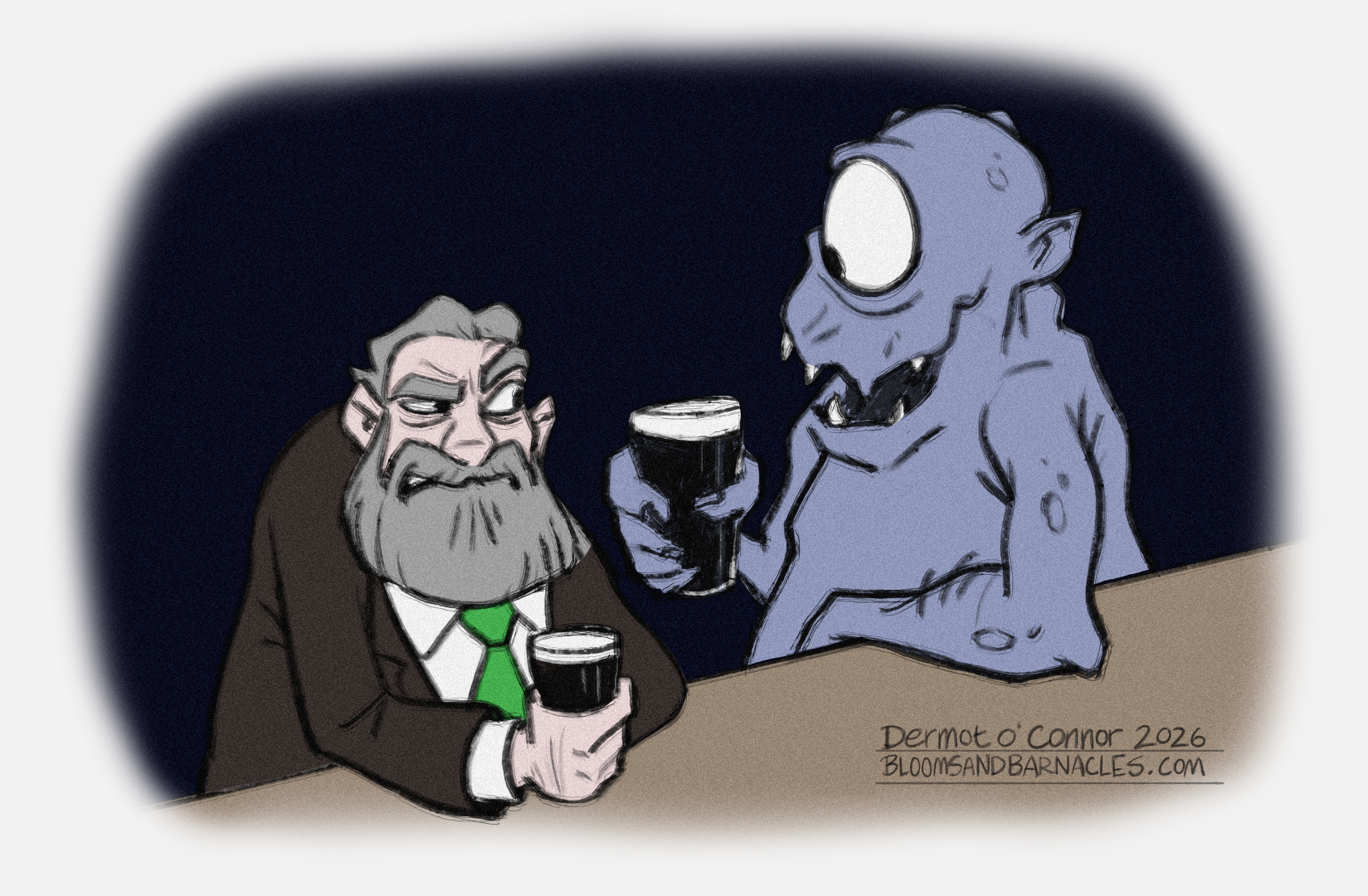
“The one-eyed man may be king in the realm of the blind, but the two-eyed man is nothing but a nuisance in the kingdom of the one-eyed.” – Frank Budgen
“The many light-hearted cross-references of this kind have lent support to the idea that Ulysses is a great joke on Homer, but jokes are not necessarily so simple, and these have a double aim. The first aim is the mock-heroic, the mighty spear juxtaposed with the two-penny cigar. The second, a more subtle one, is what might be called the ennoblement of the mock-heroic. This demonstrates that the world of cigars is devoid of heroism only to those who don’t understand that Ulysses’ spear was merely a sharpened stick, as homely an instrument in its way, and that Bloom can demonstrate the qualities of man by word of mouth as effectively as Ulysses by thrust of spear.” – Richard Ellmann
The Odyssey – Book IX
Following their misadventure with the Lotus Eaters, Odysseus and his fleet come to the home of the Cyclopes, a rude, violent and uncivilized people. Odysseus and his men enter the cave dwelling of the Cyclops Polyphemus while he is out tending to his sheep. They eat Polyphemus’ food while waiting for him. Then Polyphemus comes home and eats some of the men. Trapped in Polyphemus’ cave, Odysseus hatches a cunning plan. He and his men sharpen a big stick and then get Polyphemus blackout drunk. Once the Cyclops passes out, they light the stick on fire and gouge out Polyphemus’ eye. Then they hide beneath Polyphemus’ sheep so that he can’t find them by touch. The plan works and Odysseus and his surviving crew escape.
It’s always five o’clock somewhere. On Bloomsday, that means it’s time for “Cyclops”, Ulysses’ twelfth episode. Our hero, Leopold Bloom, is all out of sorts because of the infidelity he knows took place around 4:30 that afternoon. Bloom is a man on a mission nonetheless, arriving in hostile territory to liaise with Martin Cunningham and untangle the late Paddy Dignam’s life insurance. As readers, we don’t view this encounter through the eyes of Bloom, but rather through the eyes of an unsympathetic narrator given to gigantic, overexaggeration.
The “Cyclops” episode, paralleling the most iconic scene in The Odyssey, is packed with Odyssean imagery. Though the correspondent organ of the episode is “muscle,” it is packed to the brim with eyes. The first word of the episode is literally “I,” signifying the nameless narrator who is only ever identified by the first-person pronoun. The first thing we learn about him is that he nearly became a Cyclops himself when “a bloody sweep came along and… near drove his gear into my eye.” Later, when Bloom opts for a cigar rather than a beverage, the narrator similarly complains that Bloom nearly put his eye out with the lit end, more closely resembling Odysseus blinding Polyphemus with a burning brand.
As the narrator is nameless, he is also “No Man,” hinting at the pseudonym Odysseus gives the Cyclops’ in The Odyssey. A secondary third-person narrator, also nameless, butts in with a series of absurd and grandiose intrusions, building out the episode’s technic of gigantism. The dual narrators aren’t the only “No Mans” as the episode is replete with characters whose names we never learn, misnomers, and rude nicknames. The Citizen, the Joycean Cyclops himself, is never called by any name but “Citizen.” In this sideways version of The Odyssey, Odysseus is named but the Cyclops is No Man. In the last seven pages of the episode, author Stuart Gilbert points out that the I narrator avoids using Bloom’s name altogether. Stuart interprets this as intending to diminish and dehumanize Bloom, robbing him of his identity. However, it reveals that Bloom is the true “No Man” Odysseus. In “Ithaca,” Bloom will embrace the dual identity of Noman and Everyman.

The Citizen, holding court on a barstool, is the clear parallel Polyphemus in Dublin’s Odyssey. As with all Ulysses characters, the Citizen is a sideways version of his classical counterpart. While Polyphemus is an outcast among his people, identified in The Odyssey as a loner among loners, the Citizen thrives from the attention and adulation of others. The Citizen is no outcast; he is mighty enough that when he pitches up in the corner of a certain pub, his minions will swarm. At the very least, he doesn’t have to pay for his own booze. Unlike Odysseus and crew who gatecrash Polyphemus’ home, the Citizen invites Bloom into the pub, though it is an antagonistic invitation.
Joyce’s Odysseus, also a sideways Odysseus, is a pacifistic Odysseus. Classical Odysseus is portrayed as both a war hero and the wisest of the Greeks. Scholar Richard Ellmann argues that through Bloom, Joyce develops the theme of wisdom. Ellmann says, “Joyce makes his modern Ulysses a man who is not physically a fighter, but whose mind is unsubduable.” Though Bloom doesn’t show up spoiling for a fight, he strikes out with facts and logic at each attack, though his foes remain largely unthwarted. As the debate heats up, Bloom argues for love over hate, though this doesn’t win him any allies in the Cyclops’ cave. Ultimately, it is Bloom’s promotion of love that distinguishes him from the lesser men in Barney Kiernan’s proving, as Ellmann puts it, that he is two-eyed in the land of the one-eyed. Bloom’s humanism and love for his fellow human beings contrasts him sharply, marking him as the hero.
Even though Bloom is largely pacifist, we know that he has a hot streak, evidenced by his failed career in the cattle market and his past attendance at a political rally-turned-riot. “Cyclops” is the most pugilistic we see Bloom throughout Bloomsday. We can infer that he loses his equilibrium momentarily due to the knowledge that Boylan and Molly are together. He’s simply pushed over the edge at this moment by the brash bullies haunting this particular pub, a spot he’d tried to avoid. It’s a point in the novel where the normally genteel Bloom is not a particularly “prudent member.” He behaves impulsively, impotently lecturing an immovable object (the Citizen). Gilbert argues that Odysseus’ encounter with the Cyclops also reveals a lapse in his wisdom. It was foolish and impulsive to make camp in the Cyclops’ cave, eat his food, and assume that would go fine. We celebrate Odysseus’ cunning in solving a catastrophe of his own making. Bloom uses his cunning to land some zingers on the Citizen, but it is the quick thinking of Martin Cunningham and friends that ultimately saves Bloom’s bacon. During their flight at the end of the episode, Bloom avows his Judaism in the face of the Citizen’s bigotry. This parallels the moment in The Odyssey in which Odysseus declares his true name as his fleet escapes the Cyclops’ wrath. In response, the Citizen ineffectually hurls an empty Jacob’s biscuit tin at the fleeing car, much in the same way that Polyphemus hurls a particularly large boulder amidst Odysseus’ ships. Despite their dramatic escapes, both Bloom’s and Odysseus’ problems are just beginning. Scholar David Hayman writes:
“Like Homer’s demi-god and volcano, [the Citizen] overshadows the rest of the book’s actions. He has challenged Bloom’s manhood, made manifest his rootlessness, and complicated his return…. Before Bloom can return to Molly, he is obliged to pay for this facile and doubtful victory by initiating himself into his own inner mysteries.”
On the topic of volcanoes, Gilbert locates Cyclopia, the land of the Cyclops, near present-day Naples, Italy, specifying a small island off the the mainland that is the crater of an extinct volcano. “Cyclopia” means “the land of the eyes,” and in this case, the “eyes” are the many volcanic craters found in the region. The Cyclops in The Odyssey, then, is the personification of a volcano: a one-eyed creature “vomiting rocks and lava with hideous clamour” due to his explosive, unpredictable temper. Gilbert expands his metaphor, pointing out that the Citizen is also “clamourous and fulminant” like a volcano and that “the more liquid he absorbs, the greater his eruptive violence.” Like a volcano, the Cyclops/Citizen rejects foreigners entering his land. I didn’t previously interpret a volcano’s fury as racist, but there you have it. Volcanoes are probably racists.
The rejection of the foreigner is central to the characterization of the Cyclops in various interpretations of The Odyssey. The Citizen is portrayed as a violent anti-semite. In the Coen brothers’ film O Brother Where Art Thou?, a loose adaptation of The Odyssey, the Cyclops encounter is reimagined as a Ku Klux Klan rally. A failure to extend hospitality to an outsider was seen as a major social violation in The Odyssey. The Cyclopes are barbaric not because of their monstrous size or grotesque appearance, but because of their rugged individualism. From The Odyssey: “Each one dispenses the laws for his children and his wives and is not concerned for the others.” In other words, the Cyclopes are a bit Libertarian. The Citizen may be more sociable than Polyphemus, but we see a similar isolationist spirit in his declaration of “Sinn Fein Amhain!”
Both the Cyclops encounter in The Odyssey and the “Cyclops” episode of Ulysses are, at their hearts, tragicomedies of error, specifically errors of hospitality. Polyphemus commits a transgression of hospitality against Odysseus and his crew, as it is generally considered bad hospitality to devour your guests. Hospitality is a point where modern and ancient sensibilities diverge, as I can’t imagine most of us warmly greeting a band of sailors who broke into our house and ate our food while we were at work. Polyphemus does offer Odysseus a gift, offering to eat him last, but it’s hard to imagine Odysseus mustering much gratitude for such a gift. Gilbert wrote that it was through hospitality that ancient travelers would try to quell the wrath of the People of the Eyes. If you got them drunk enough with “gifted” wine, you could sneak out the back door rather than getting devoured. Odysseus does eventually employ this tactic, but not swiftly enough to avoid a moderate amount of devouring. Odysseus’ gift to Polyphemus is an echo of the Trojan Horse, as he intoxicates Polyphemus with exotic wine while intending to exploit Polyphemus’ drunkenness to blind and potentially murder him in his own home. If Odysseus had followed the rules of hospitality, he could have prevented an awful lot of devouring and maiming. Such deceit and cunning (especially with regards to the Trojan Horse) is what lands Odysseus in one of the deepest circles of Hell in Dante’s Inferno.
A similar demand is part and parcel of the drinking culture in Barney Kiernan’s – pacify the Citizen with booze or face his wrath. Bloom, like Odysseus, fails to make this strategic calculation and faces the violence of the Dublin Cyclops as a result. Barney Kiernan’s is also ruled by the laws of hospitality and reciprocity. The ancient Greeks valued these qualities as well; Odysseus recounts his adventures to Nausicaa’s people in exchange for food and hospitality. In the pub, men treat one another with the expectation of being treated in return. Bloom, however, conspicuously exempts himself from this exchange. From Bloom’s point of view, he is only waiting in the pub to meet Martin Cunningham, not to get loaded with the boys, so it makes sense to opt for a simple cigar. In general, Bloom finds boozing, gambling, and the overblown nationalistic rhetoric of the pub personally and societally depleting, as he has repeatedly considered up to this point in the novel. A rumor rapidly spreads that Bloom had a hot tip on Throwaway and has cleaned up while everyone else lost betting on Sceptre and Zinfandel. Not only did Bloom fail to share his tip (except with his bestie Bantam Lyons for some reason), but now he is withholding his massive winnings from the men in the bar, an assumption bolstered by rank antisemitism. Scholar Mark Osteen identifies a no-win state for ol’ Bloom. He’s in trouble for being stingy if he had won (inadvertently playing into antisemitic stereotypes in the process), but it’s almost worse, Osteen writes, that Bloom has refused to gamble at all, as “his frugality makes the others’ losses look more futile.”
Osteen likens the informal economy of Barney Kiernan’s to the potlatch ceremony, a system of gift-giving practiced by indigenous cultures in the Pacific Northwest of North America. During a potlatch ceremony, various leaders try to outdo one another through displays of generosity, competing to give their rivals the most ostentatious gifts. The potlatch is essentially competitive generosity. Osteen explains that it is through expenditure rather than accrual that power and prestige are gained by the rival groups. However, there are three obligations of participants in the potlatch – giving, receiving, and reciprocating. If your rival is unable to top your gift, he is defeated because it means he is unable to afford to give a greater extravagance. Osteen wrote, “to fail in any of the three [obligations] is to suffer social humiliation and loss of honor.” With this in mind, we can easily see the aggression built into the “generosity” of a potlatch gift. A rival can be destroyed by being burdened with too much reciprocal obligation. Furthermore, participation in the potlatch is compulsory.

In Osteen’s view, the atmosphere of Barney Kiernan’s pub is “a microcosmic version of the potlatch ceremony.” Everyone is treated and everyone treats, though the economic losses are generally greater than the gains. In return, the men enjoy the insulation of social acceptance. They are all participating in the corrosive habits of drinking and gambling that Bloom identifies correctly as toxic aspects of Dublin social culture. However, by participating collectively, everyone remains similarly burdened and none rise above the others. By trying to break free of this system, Bloom is perceived as hoarding resources that are meant to be dispersed amongst the group via an unofficial system of competitive and punitive generosity. By rejecting both treating and being treating, he is rejecting the social bonds fostered by this system, communicating, inadvertantly, that he is above the other men. Even Bloom’s appeals to Christian charity violate this system. Charity is meant to alleviate the suffering of others. However, social cohesion is created through equal suffering.
Osteen argues that this makes losing at gambling better in some ways than winning. Most gamblers lose money, so losing provokes solidarity rather than scorn. A bigger loss confers greater prestige. For instance, we learn in “Cyclops” that Blazes Boylan loses two quid on Sceptre, but later in “Penelope” we learn that he tells Molly he lost 20, making him seem like a high roller able to absorb an exorbitant loss, gaining prestige through expenditure rather than accrual as in the potlatch. Even Lenehan the parasite pivots his gambling losses into free drinks of consolation. A large win, by contrast, embitters the losers and leads to suspicion and even violence. A winner is alienated while losers can unite in their loss. It’s a classic bucket of crabs scenario. A single crab can easily climb out of a bucket, but if there are several crabs in the bucket, they will pull one another down as they simultaneously try to escape, resulting in none of them escaping. The King Crab of Dublin might even hurl a biscuit tin at you in your attempt. Bloom is revealed the hero because he escapes in the end rather than being dragged down.
Further Reading:
- Budgen, F. (1972). James Joyce and the making of Ulysses, and other writings. London: Oxford University Press. Retrieved from https://search.library.wisc.edu/digital/AMF2PZFZHI2WND8U
- Ellmann, R. (1959). James Joyce. Oxford University Press.
- Ellmann, R. (1972). Ulysses on the Liffey. Oxford University Press. Retrieved from https://archive.org/stream/in.ernet.dli.2015.65767/2015.65767.Ulysses-On-The-Liffey_djvu.txt
- Gilbert, S. (1930). James Joyce’s Ulysses: a study. New York: Vintage Books. Retrieved from https://archive.org/details/in.ernet.dli.2015.124373/page/n3/mode/2up
- Hayman, D. (1974). Cyclops. In C. Hart & D. Hayman (eds.), James Joyce’s Ulysses: Critical essays (91-114). Berkeley: University of California Press. Retrieved from https://tinyurl.com/wu2y7mg
- Homer, translated by Palmer., G.H. (1912). The Odyssey. Mineola, New York: Dover Publications.
- Kenner, H. (1987). Ulysses. Baltimore: The Johns Hopkins University Press.
- Osteen, M. (1990). The Intertextual Economy in “Scylla and Charybdis.” James Joyce Quarterly, 28(1), 197–208. http://www.jstor.org/stable/25485125
- Schwarz, D. (2004). Reading Joyce’s Ulysses. Palgrave Macmillan.