
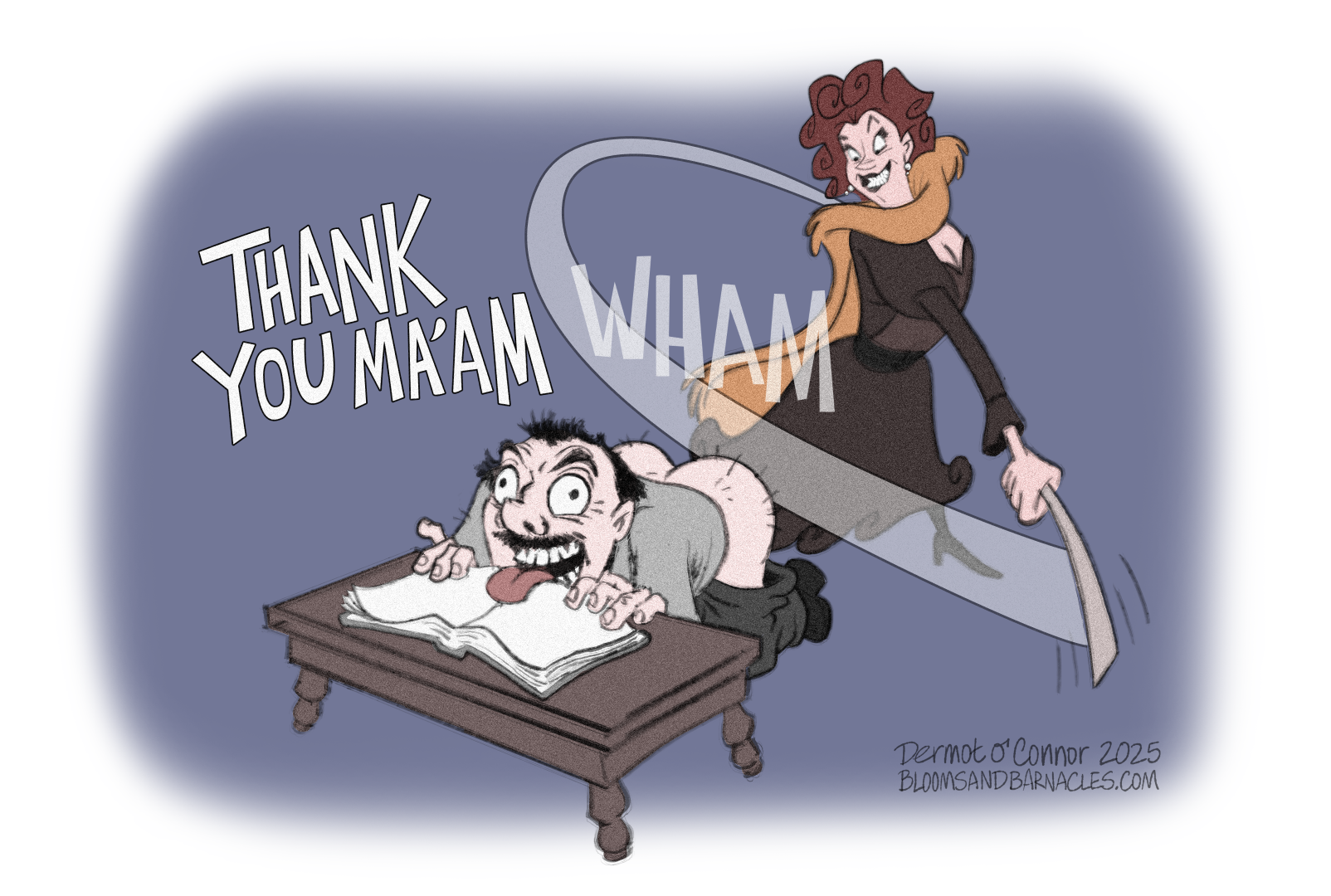
Put on your costliest frillies!

Topics in this episode include Bloom’s literary interest, Aristotle’s Masterpiece, Fair Tyrants, Victorian flagellation literature, Molly’s desire for some decent erotica, the origins of Sweets of Sin, why Bloom chooses Sweets of Sin, Leopold von Sacher-Masoch, the novel Venus in Furs, masochism in literature, Bloom’s inclination towards masochism, Joyce’s interest in masochism, the influence of Venus in Furs on Ulysses, Joyce’s love letters, and why it matters that Bloom is a “womanly man.”
Support us on Patreon to get episodes early, and to access bonus content and a video version of our podcast.

A blog and podcast that discuss James Joyce’s Ulysses from a non-academic point of view. Less snooty, more movie references.
Put on your costliest frillies!
Topics in this episode include Bloom’s literary interest, Aristotle’s Masterpiece, Fair Tyrants, Victorian flagellation literature, Molly’s desire for some decent erotica, the origins of Sweets of Sin, why Bloom chooses Sweets of Sin, Leopold von Sacher-Masoch, the novel Venus in Furs, masochism in literature, Bloom’s inclination towards masochism, Joyce’s interest in masochism, the influence of Venus in Furs on Ulysses, Joyce’s love letters, and why it matters that Bloom is a “womanly man.”
On the Blog:
Blooms & Barnacles Social Media:
Facebook | BlueSky | Instagram
Subscribe to Blooms & Barnacles:

On the Blog:
Blooms & Barnacles Social Media:
Facebook | BlueSky | Instagram
Subscribe to Blooms & Barnacles:
Apple Podcasts | Spotify | YouTube


Further Reading:
Brown, R. (1985). James Joyce and sexuality. Cambridge University Press. Retrieved from https://archive.org/details/bwb_P8-DJA-693/page/132/mode/2up
Davison, N. R. (1998). James Joyce, Ulysses, and the Construction of Jewish Identity: Culture, Biography and ‘the Jew’ in Modernist Europe. Cambridge: Cambridge University Press. Retrieved from https://tinyurl.com/rp9ctrt
Ellmann, R. (1959). James Joyce. Oxford University Press.
Gabler, H. W. (2018). Structures of Memory and Orientation: Steering a Course Through Wandering Rocks. In Text Genetics in Literary Modernism and other Essays (1st ed., pp. 81–110). Open Book Publishers. http://www.jstor.org/stable/j.ctv8j3xd.7
Gifford, D., & Seidman, R. J. (1988). Ulysses annotated: Notes for James Joyce’s Ulysses. Berkeley: University of California Press. Retrieved from https://tinyurl.com/vy6j4tk
Hart, C. (1974). Wandering Rocks. In C. Hart & D. Hayman (eds.), James Joyce’s Ulysses: Critical essays (181-216). Berkeley: University of California Press. Retrieved from https://tinyurl.com/wu2y7mg
Osteen, M. (1995). The economy of Ulysses: making both ends meet. New York: Syracuse University Press. Retrieved from https://tinyurl.com/yycf2ar5
POWER, T. (2017). “Married His Cook to Massach”: Masochistic Fiction in Ulysses. Joyce Studies Annual, 135–162. https://www.jstor.org/stable/26798614
Schwarz, D. (2004). Reading Joyce’s Ulysses. Palgrave Macmillan.
Siegel, C. (1987). “Venus Metempsychosis” and Venus in Furs: Masochism and Fertility in Ulysses. Twentieth Century Literature, 33(2), 179–195. https://doi.org/10.2307/441315
Thornton, W. (1968). Allusions in Ulysses: An annotated list. Chapel Hill: The University of North Carolina Press. Retrieved from https://archive.org/details/allusionsinulyss0000thor
Watt, S. (1996). “Nothing for a woman in that”: James Lovebirch and masochistic fantasy in Ulysses. In B. Kershner (ed.),James Joyce and popular culture (74-88). Gainesville: University of Florida Press. Retrieved from https://archive.org/details/isbn_813013968/mode/2up
Leave a Reply