
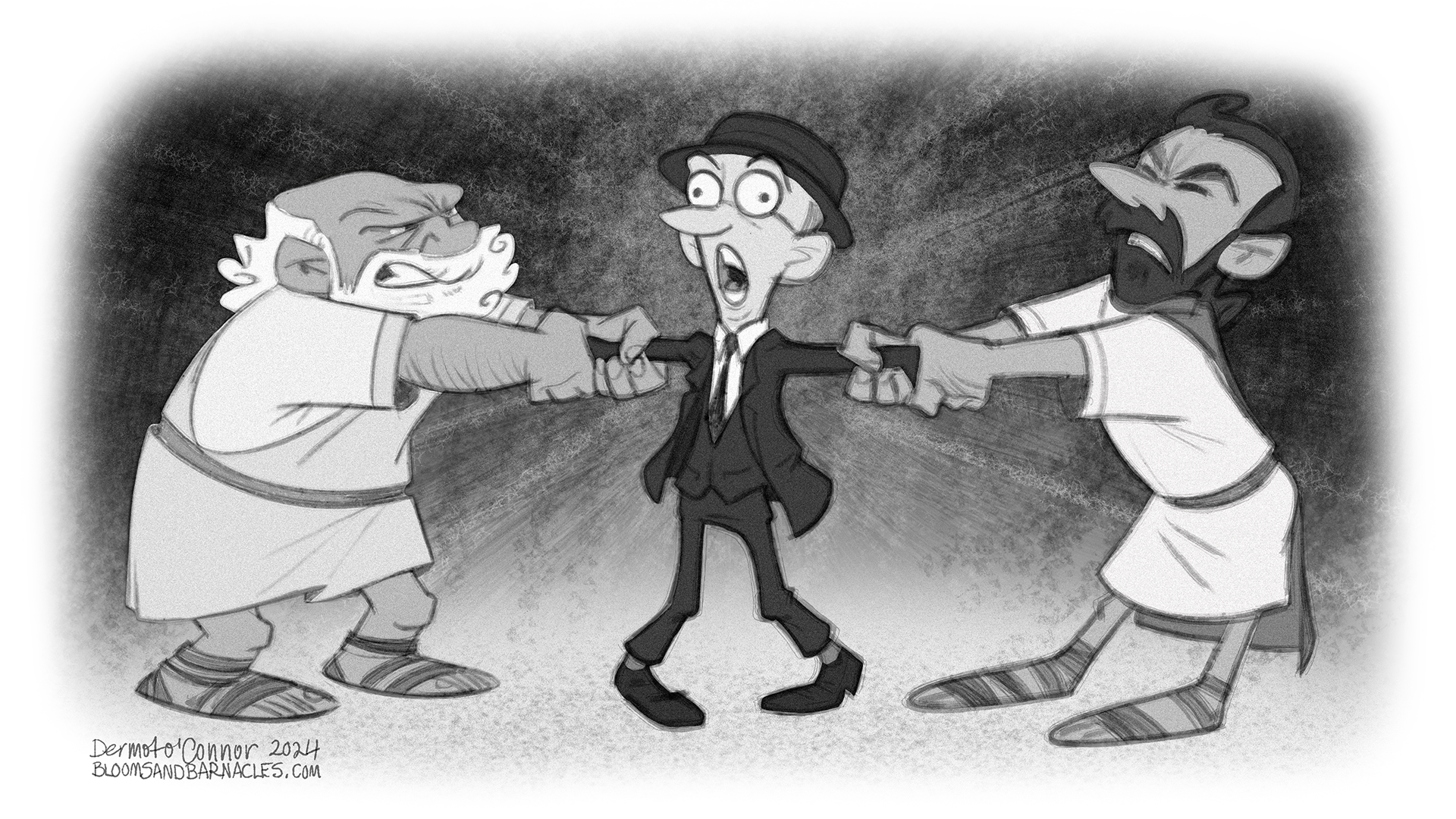
You naughtn’t to look, missus, so you naughtn’t when a lady’s ashowing of her elemental.

Topics in this episode include Old Ben’s critique of Shakespeare, bardolatry, Shakespeare as a symbol of English supremacy, how Plato is like Charybdis, formless spiritual essences, seeing ourselves as others see us, the paintings of Gustave Moreau, and so much theosophy.
Support us on Patreon to access episodes early, bonus content, and a video version of our podcast.

On the Blog:
Decoding Dedalus: Horseness is the whatness of allhorse.
Blooms & Barnacles Social Media:
Facebook | BlueSky | Instagram
Subscribe to Blooms & Barnacles:
Apple Podcasts | Spotify | YouTube
Further Reading:
- Beck, H. Æ IOU: two debts to Russell? James Joyce Online Notes. Retrieved from https://www.jjon.org/joyce-s-allusions/russell-debt
- Dilworth, T., & Marrero, K. (1990). A.E.I.O.U.: Plato and Rimbaud in “Scylla and Charybdis.” James Joyce Quarterly, 28(1), 298–301. http://www.jstor.org/stable/25485137
- Erzgräber, W. (1987). Art and Reality: An Interpretation of “Scylla and Charybdis.” James Joyce Quarterly, 24(3), 291–304. http://www.jstor.org/stable/25476812
- Gifford, D., & Seidman, R. J. (1988). Ulysses annotated: Notes for James Joyce’s Ulysses. Berkeley: University of California Press. Retrieved from https://tinyurl.com/vy6j4tk
- Gilbert, S. (1955). James Joyce’s Ulysses: a study. New York: Vintage Books. Retrieved from https://archive.org/details/in.ernet.dli.2015.124373/page/n3/mode/2up
- Hunt, J. (2022). This side idolatry. The Joyce Project. Retrieved from https://www.joyceproject.com/notes/090007idolatry.htm
- Ito, E. (2003). Mediterranean Joyce Meditates on Buddha. Language and Culture, No.5 (Center for Language and Culture Education and Research, Iwate Prefectural University), 53-64. Retrieved from http://p-www.iwate-pu.ac.jp/~acro-ito/Joycean_Essays/MJMonBuddha.html
- Jenkins, R. (1969). THEOSOPHY IN “SCYLLA AND CHARYBDIS.” Modern Fiction Studies, 15(1), 35–48. http://www.jstor.org/stable/26279201
- Kellogg, R. (1974). Scylla and Charybdis. In C. Hart & D. Hayman (eds.), James Joyce’s Ulysses: Critical essays (147-179). Berkeley: University of California Press. Retrieved from https://tinyurl.com/wu2y7mg
- Kenner, H. (1987). Ulysses. Baltimore: The Johns Hopkins University Press.
- Michels, J. (1983). “Scylla and Charybdis”: Revenge in James Joyce’s “Ulysses.” James Joyce Quarterly, 20(2), 175–192. http://www.jstor.org/stable/25476502
- O’Rourke, F. (2016). Aristotelian Interpretations. Newbridge: Irish Academic Press.
- O’Rourke, F. (2018). Knowledge and Identity in Joyce. In: Belluc, S., Bénéjam, V. (eds) Cognitive Joyce. Cognitive Studies in Literature and Performance. Palgrave Macmillan, Cham.
- O’Rourke, F. (2022). Joyce, Aristotle, and Aquinas. Gainesville: University of Florida Press.
- RASMUSSEN, I. D. (2019). Riffing on Shakespeare: James Joyce, Stephen Dedalus, and the Avant-Garde Theory of Literary Creation. Joyce Studies Annual, 33–73. https://www.jstor.org/stable/26862950
- Sharpe, G. (1963). THE PHILOSOPHY OF JAMES JOYCE. Modern Fiction Studies, 9(2), 120–126. http://www.jstor.org/stable/26278465
- Sun, L. Scylla and Charybdis – Modernism Lab. Retrieved from https://campuspress.yale.edu/modernismlab/scylla-and-charybdis/
- White, L. W. (Dec 2013). Dunlop, Daniel Nicol. The Dictionary of Irish Biography. Retrieved from https://www.dib.ie/biography/dunlop-daniel-nicol-a9602
- Wiedenfeld, L. (2013). The Other Ancient Quarrel: “Ulysses” and Classical Rhetoric. James Joyce Quarterly, 51(1), 63–79. http://www.jstor.org/stable/24598847