
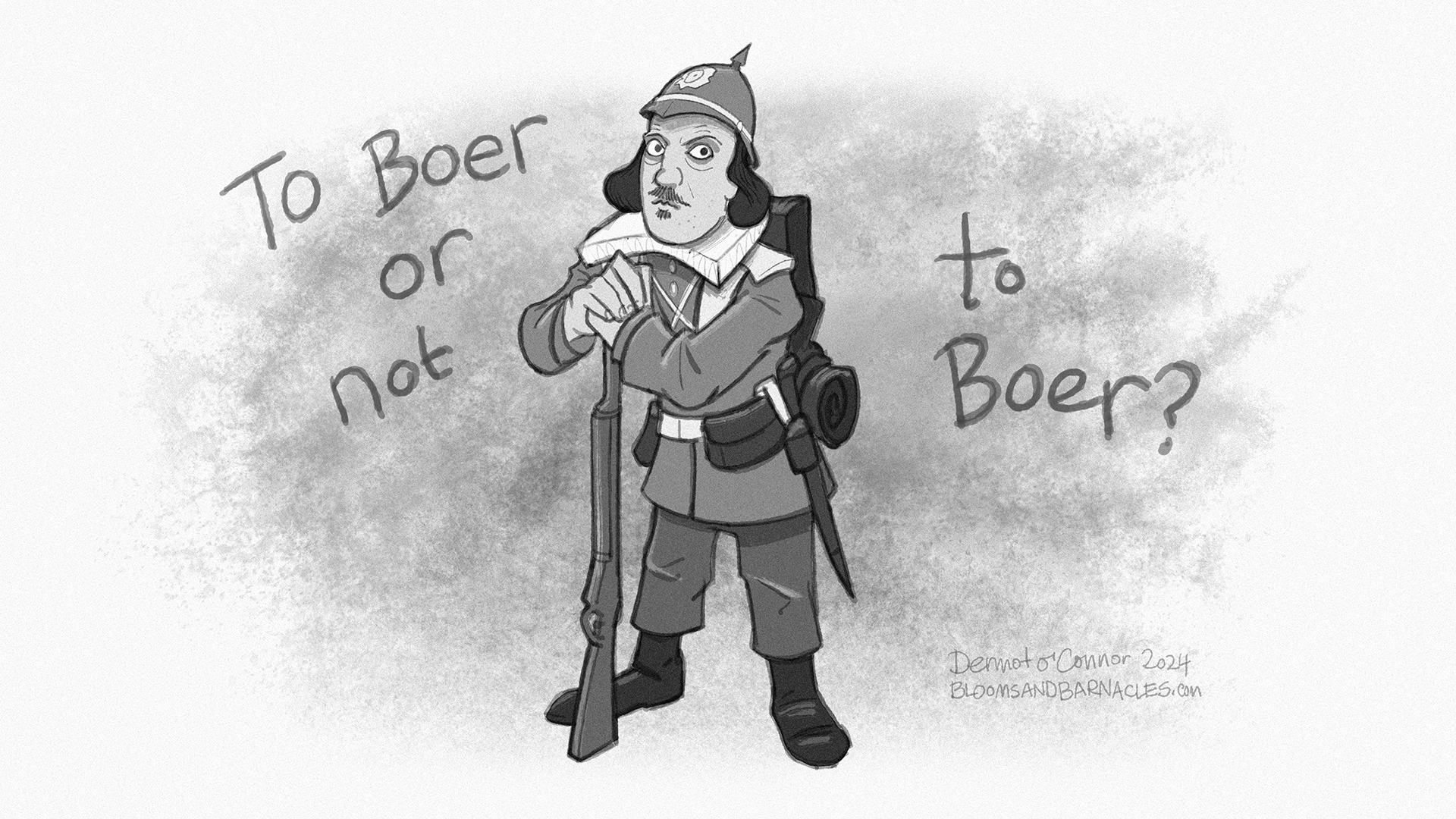
Was Hamlet just distracted the whole time?

Topics in this episode include: the continued character assassination of Mr. Best, Haines makes a return, Douglas Hyde’s poetry, the artistic ethos of the Celtic Revival, the political demands of the art scene in 1904 Dublin, Æ, symbolist poetry and Stéphane Mallarmé, the influence of Mallarmé on Joyce, “Hamlet et Fortinbras,” Rudyard Kipling and “The Absentminded Beggar,” the politics of the Boer War in 1904, Shakespeare as propaganda, Khaki Hamlets and the brutality of Shakespeare, the Mitchelstown Massacre, Algernon Swinburne and “On the Death of Colonel Benson,” British use of concentration camps during the Boer War, and further use of British literary icons as propaganda.
Support us on Patreon to access episodes early, bonus content, and a video version of our podcast.
On the Blog:

Decoding Dedalus: Hamlet, ou le Absentminded Beggar
Blooms & Barnacles Social Media:
Facebook | Twitter | Instagram
Subscribe to Blooms & Barnacles:
Apple Podcasts | Spotify | YouTube
Further Reading:
- Booker, K. (2000). Ulysses, capitalism, and colonialism – Reading Joyce after the Cold War. Retrieved from https://tinyurl.com/ye22apss
- Brown, R. (1999). The Absent-Minded War: The Boer War in James Joyce’s Ulysses. Kunapipi, 21 (3), 81-89. Retrieved from https://core.ac.uk/download/pdf/232895035.pdf
- Carpenter, W. (1998). ‘Le livre’ of Mallarmé and James Joyce’s Ulysses. In R. Greer Cohn & G. Gillespie (eds.), Mallarmé in the twentieth century (187-203). London: Associated University Presses. Retrieved from https://tinyurl.com/ynwtd8bp
- Cheng, V. (1995). Joyce, race, and empire. Cambridge University Press. Retrieved from https://archive.org/details/joyceraceempire0000chen/page/n7/mode/2up
- Fordham, F. (2016). James Joyce and Rudyard Kipling: Genesis and Memory, Versions and Inversions. European Joyce Studies, 25, 181–200. http://www.jstor.org/stable/44871411
- GABLER, H. W. (2021). James Joyce’s Hamlet Chapter: Stepping Stone to Scylla and Charybdis. Joyce Studies Annual, 178–216. https://www.jstor.org/stable/48654020
- Janusko, R. Hamlet’s sledded poleaxe. James Joyce Online Notes. Retrieved from https://www.jjon.org/joyce-s-words/sledded
- KENNY, T. J. (2019). The Image of Mallarmé in “Scylla and Charybdis.” Joyce Studies Annual, 241–246. https://www.jstor.org/stable/26862959
- Marchi, D. M. (1995). PARTICIPATORY AESTHETICS: READING MALLARMÉ AND JOYCE. The Comparatist, 19, 76–96. http://www.jstor.org/stable/44366897
- RASMUSSEN, I. D. (2019). Riffing on Shakespeare: James Joyce, Stephen Dedalus, and the Avant-Garde Theory of Literary Creation. Joyce Studies Annual, 33–73. https://www.jstor.org/stable/26862950
- Ryan, B. (2013). Mythologising the Exiled Self in James Joyce and Fernando Pessoa (2013). Pessoa Plural (Www.pessoaplural.com).
- Temple-Thurston, B. (1990). The Reader as Absentminded Beggar: Recovering South Africa in “Ulysses.” James Joyce Quarterly, 28(1), 247–256. http://www.jstor.org/stable/25485129
- Toker, L. (2015). “Khaki Hamlets Don’t Hesitate”: A Semiological Reading of References to the Boer War and Concentration Camps in Joyce’s Ulysses. Journal of Modern Literature, 38(2), 45–58. https://doi.org/10.2979/jmodelite.38.2.45
- Weir, D. (1980). Stephen Dedalus: Rimbaud or Baudelaire? James Joyce Quarterly, 18(1), 87–91. http://www.jstor.org/stable/25476341