Wandering Rocks
-
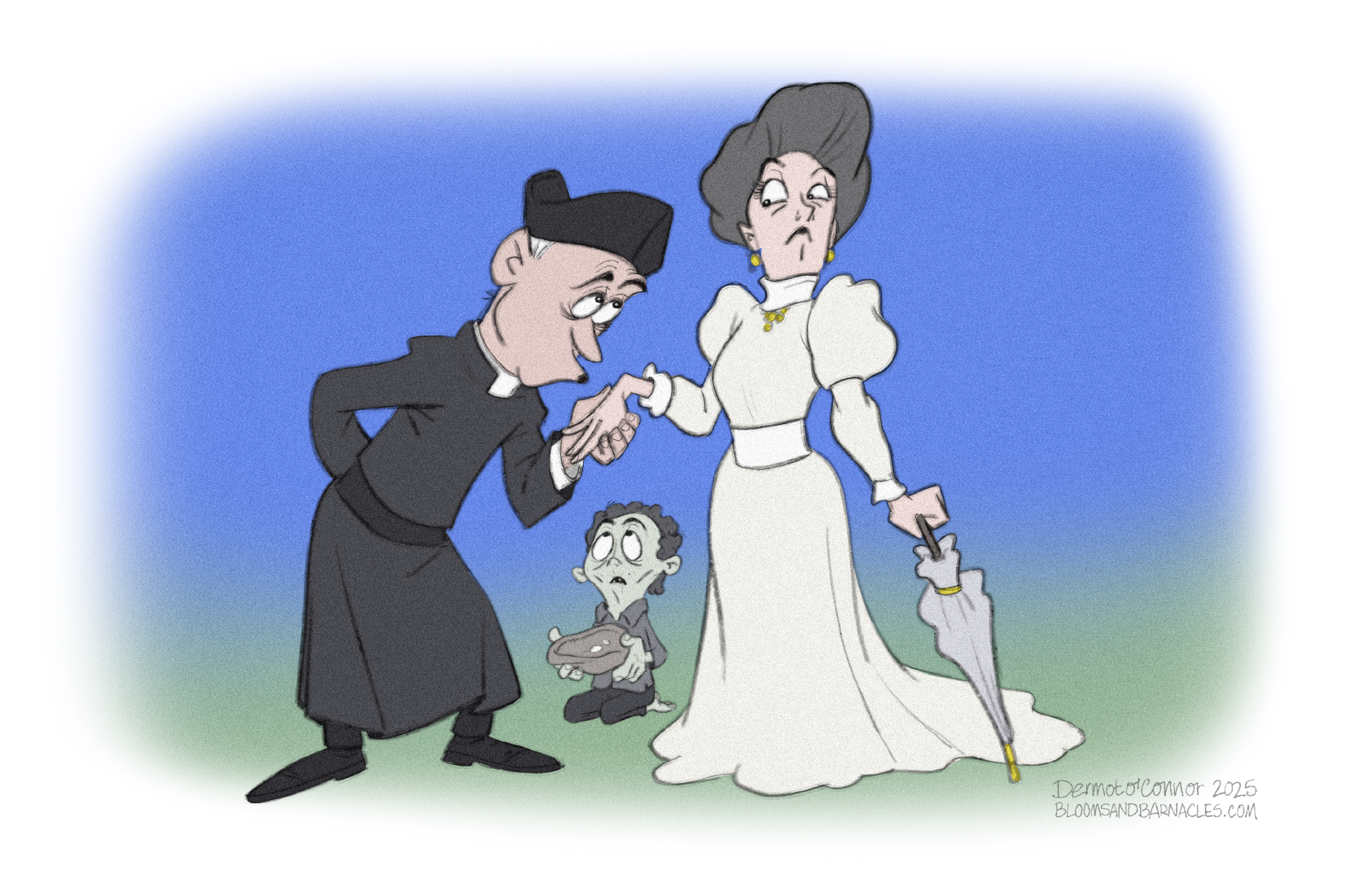
Ep. 175 – Father Conmee
What is Dublin without Church and State? Topics in this episode include Stephen/Joyce’s past with Father Conmee, what Father Conmee represents, the eternal battle between Church and State (is it even a battle?), the collusion between Church and State, Father Conmee’s fondness for high-class women, which children Father Conmee likes, Father Conmee’s love of the…
-
Ep. 174 – The Wandering Rocks
Here be dragons. Topics in this episode include why “Wandering Rocks” is the least Homeric episode of Ulysses, why the name “Wandering Rocks” isn’t quite right, how Jason escaped the Wandering Rocks, how Leopold Bloom is a mightier hero than Odysseus, correspondences for “Wandering Rocks,” the “blind mechanism” of the Wandering Rocks, clockspeed, how to…
-
Stephen Dynamo
In the thirteenth section of “Wandering Rocks,” Ulysses’ tenth episode, we meet Stephen Dedalus once again, gazing into the window of Old Russell the lapidarist. We last saw Stephen descending the stairs of the National Library with Buck Mulligan in “Scylla and Charybdis,” seeking augury from absentee birds. Mulligan is meeting Haines at the DBC…
-
Sweets of Sin
“… a volume of peccaminous pornographical tendency entitled Sweets of Sin, anonymous author a gentleman of fashion…” “…I wonder what kind is that book he brought me Sweets of Sin by a gentleman of fashion some other Mr de Kock …” In the tenth section of “Wandering Rocks,” the tenth episode of Ulysses, we rejoin…
-
The Most Historic Spot in All Dublin
“History in ‘Wandering Rocks’ is not only colonial history registered in the fabric of the city; it is also quite specifically colonial history distorted and dominated by Protestant and Anglo-Irish interpretations.” – Len Platt The eighth section of Ulysses’ tenth episode, “Wandering Rocks” opens with “two pink faces” greeting a third in some dark, dusty…
-
Who was the real Almidano Artifoni?
This post is a part of an occasional series on the real people behind the characters in Ulysses. In the sixth vignette of Ulysses’ tenth episode, “Wandering Rocks,” we see Stephen Dedalus chatting with Almidano Artifoni, a music maestro with comically starchy trousers. Their conversation is written entirely in untranslated Italian, so if, like me,…
-
The Superior, The Very Reverend John Conmee S. J.
“The tidal waterway, the Anna Liffey, mother of Dublin, plays as ever her part in Joyce’s Dublin. As a creative force she is older and greater than Christ or Caesar. If Christ left Dublin the city would still exist. Man can invent fresh gods as he needs them and new gods would replace the old;…
-
Ulysses & The Odyssey – Wandering Rocks
‘Wandering Rocks,’” following immediately on Stephen’s theorizing, is Joyce’s most complete celebration of Dublin, demonstrating succinctly his conception of the importance of physical reality, meticulously documented, as the soil from which fictions may best grow.” – Clive Hart The Odyssey – Book XII Circe advises Odysseus on how to sail safely home. She warns him…
-
Is Blazes Boylan really the worst man in Dublin?
—Ay, now I remember, Nosey Flynn said, putting his hand in his pocket to scratch his groin. Who is this was telling me? Isn’t Blazes Boylan mixed up in it? Author’s note: If you’re interested in further exploring the psyche of Blazes Boylan, I recommend checking out Margot Norris’ excellent article, Don’t Call Him “Blazes”:…
-
Who was the real Cashel Boyle O’Connor Fitzmaurice Tisdall Farrell?
“Dubliners were proud of Endymion. They were proud that they tolerated Endymion, but also that he tolerated them. Most people watched him and remembered him with affection, and only a few were aware of the darker side to some of his mutterings.” – John Simpson This post is a part of an occasional series on…